Thank you for your interest in screening your clients for perinatal mental health challenges!
Screening increases detection, referral, and treatment for perinatal mental health challenges. While more education and training are needed than is provided here, this page offers an overview of steps you'll need to take as well as an introduction to a few validated screening tools that are in the public domain and are commonly used for perinatal screening: the Edinburgh Postnatal Depression Scale, the Columbia Suicide Severity Rating Scale, and the Generalized Anxiety Disorder 7-item Scale.
Effectively screening and referring clients for perinatal mental health challenges requires learning about those challenges and their risk factors, ethical mandates for screening, effective screening tools, and appropriate screening and referral policies and practices.
Screening is not diagnosis. It is a way of identifying which clients may benefit from evaluation, diagnosis, and treatment by a care provider qualified to do so. Which practioners will you refer to once you screen a client and that screening suggests a need for referral? Do those practitioners specialize in perinatal mental health care? Will they facilitate informed decision making regarding a wide variety of treatment options? Do they know how and why to provide lactation-compatible mental health care? Will they refer to and coordinate treatment with other care providers to ensure that all needed treatment is accessible? Before you screen, you must identify the care providers in your community most capable of helping your clients move toward greater well being.
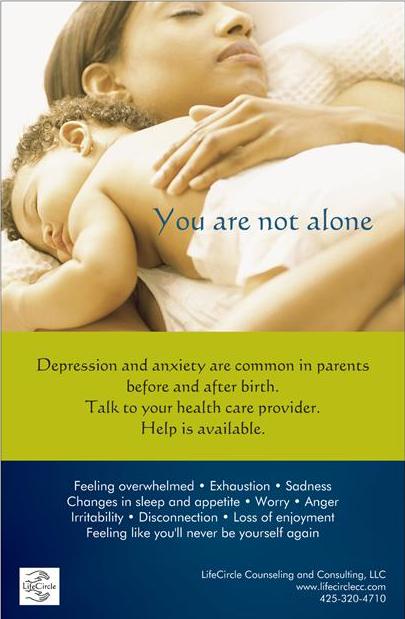
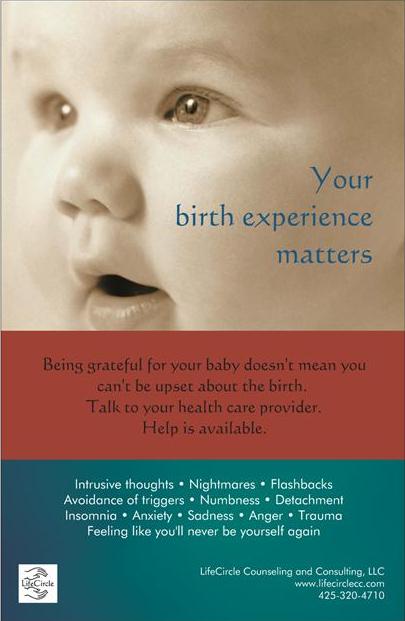
Posters, brochures or information sheets, resource and referral lists, and screening tools (see the box to the right) are necessary for educating clients about perinatal mental health challenges and treatment options and for identifying the need for referral. They also serve to communicate to clients how common depression, anxiety, and traumatic stress are in the perinatal time period. This can help reduce a sense of stigma and increase the likelihood of accessing evaluation and treatment. And, they also provide clients with the information they need to recognize the symptoms of depression, anxiety, and traumatic stress should they develop sometime after the screening.
(Because individuals of any gender can experience mental health challenges during pregnancy and after birth, my mental health awareness posters and information sheets incorporate gender-neutral language. Maternal mental health awareness posters, flyers, and cards with gendered language are available from the 2020 Mom Project.)
Many people conceal their struggle with depression, anxiety, traumatic stress, and other mental health challenges out of fear of judgment. And, perinatal mental health challenges can develop at any point during pregnancy or the first year after birth. Universal screening substantially increases the likelihood of perinatal care providers successfully identifying when a referral for further evaluation and possible diagnosis and treatment is needed.
Practicing talking about screening, practicing screening, and practicing making a referral can help you increase your comfort, confidence, and skill. You can practice on your own or with other care providers who are also newly incorporating or have already incorporated universal screening into their work with clients.
A variety of screening tools and questionnaires can help you talk with your clients about perinatal mental health challenges and identify who is in need of referral. See the box to the right for descriptions and links for the Edinburgh Postnatal Depression Scale, the Columbia Suicide Severity Rating Scale, and the Generalized Anxiety Disorder 7-item Scale. Screening should occur at every visit with every client prenatally and during the first year after birth.
Many screening tools result in a single number score which suggests the possibility of a mental health challenge. Clients who score higher than the cut off for that screening tool or meet other requirements stated in the screening tool should be referred for evaluation and possible diagnosis and treatment by a qualified mental health care provider. You should always refer clients for appropriate evaluation if you suspect a mental health challenge even if the referral criteria for a particular screening tool is not met.
Provide all clients with information about the symptoms of depression, anxiety, and traumatic stress, as well as resources for help. Anticipatory guidance will help them to recognize that they need and deserve help and to take action to get that help should symptoms develop some time after screening. Earlier evaluation, diagnosis, and treatment protect parents and their children from being harmed by untreated perinatal mental health challenges.
Edinburgh Postnatal Depression Scale (EPDS)
The Edinburgh Postnatal Depression Scale is a 10-item, evidence-based tool developed to screen for postpartum depression in new mothers. It has also been validated for screening for depression during pregnancy and for screening for postpartum depression in fathers. It yields a single score which indicates the possibility of postpartum depression. It also has items that assess symptoms of anxiety, which commonly occur in perinatal depression. It is free for public use as long as proper credit is given to its creators.
Because the original EPDS is not worded to facilitate screening of anyone other than postpartum women, I have made a gender/prenatal/postpartum inclusive version of the EPDS available here.
Columbia Suicide Severity Rating Scale (C-SSRS)
Whenever a client scores 1 or higher on question #10 of the Edinburgh Postnatal Depression Scale, their suicide risk should be assessed. The Columbia Suicide Severity Rating Scale is a free questionnaire that health care providers, mental health care providers, paraprofessionals, peer counselors, and lay people can use to assess the risk of suicide. Different versions of the C-SSRS are available for use in various settings. Information and training on the use of the C-SSRS are available online. Translations of the C-SSRS are available in over 100 languages.
Generalized Anxiety Disorder 7-item (GAD-7) Scale
The Generalized Anxiety Disorder 7-item Scale is an evidence-based tool developed to screen for generalized anxiety, as well as for panic disorder, social anxiety disorder, and post-traumatic stress disorder. It has also been validated for use during pregnancy and postpartum. It yields a single score which indicates the possibility of an anxiety disorder. It is in the public domain and free for public use.
The GAD-7 and instructions for its use are available here.
I provide training on the use of perinatal screening tools in some of my presentations, such as "The Rug Pulled Out from Underneath Me Depression During Pregnancy and After Birth" and "Postpartum Depression: The Most Common Complication of Birth." I also provide customized training for small and large groups, as well as consultation for professionals seeking to learn more about screening for perinatal mental health challenges.
I provide perinatal counseling services and professional consultation and training related to perinatal mental health challenges. Please contact me anytime! I would be happy to help you learn more.